


Rafał Zajko
Klatka
FSP ING 0299
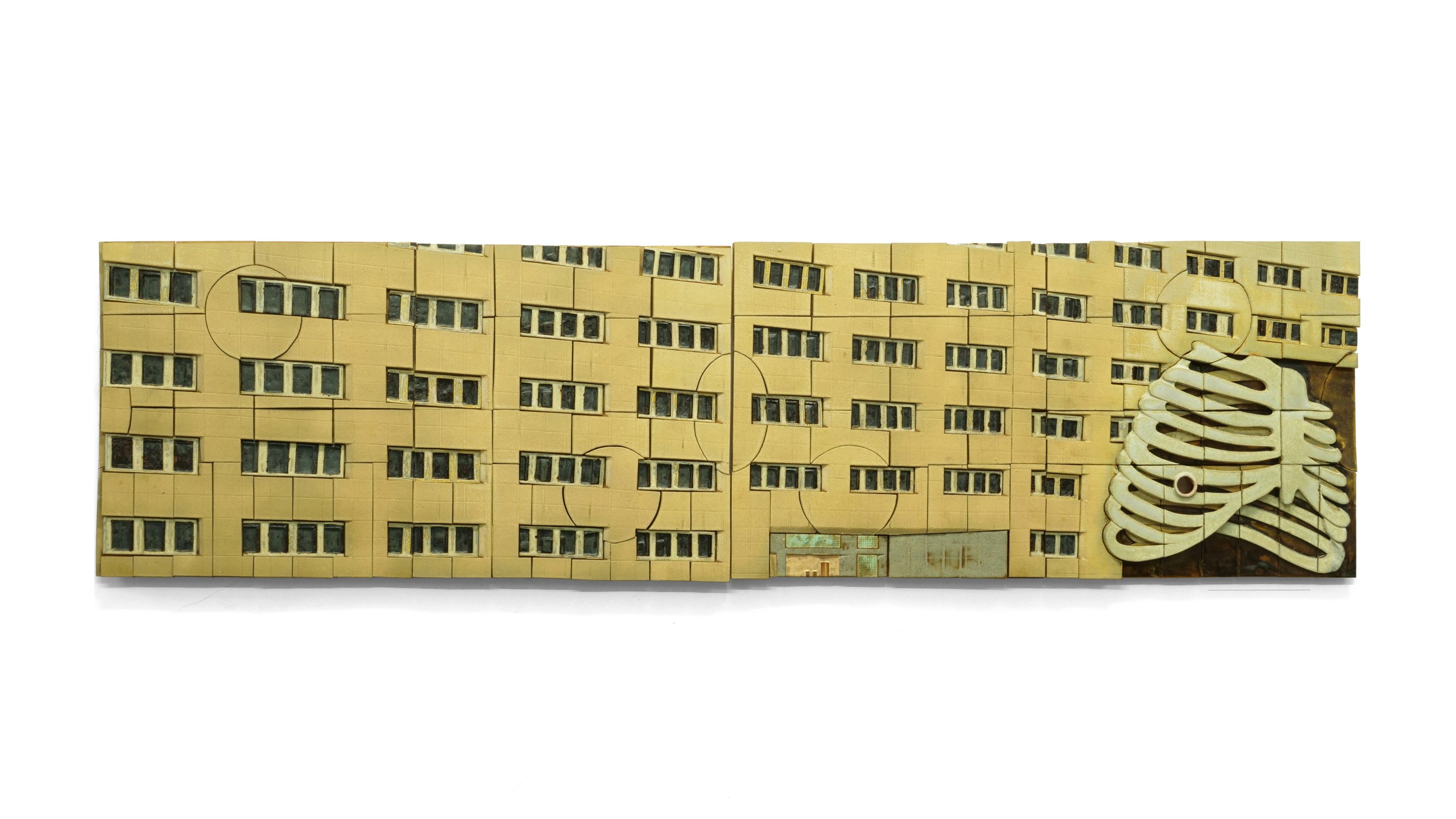

Klatka [Stairwell/Chest/Cage] was created at a time when the anti-immigration slogan “Be Like Poland” was gaining traction in the British media. Poland was portrayed as a bastion of public safety and national sovereignty, held up as a model for securing and policing borders. Zajko is interested in systems and structures that embody the complex relationship between care and control, shelter and discipline. These can take the form of states, buildings or even our own bodies.
In Polish, the word „klatka” carries multiple meanings at once: it can denote a rib cage, a stairwell, or a cage, linking the body, architecture, and confinement within a single term. This very ambiguity, embedded in the word itself, became the starting point for the relief. Within it, one might find a heart, residents of a block of flats, lungs, domestic and farm animals, guests, or intruders. A performer can intervene in this web of meanings by inserting a finger into a small opening in the sculpture. The gesture may evoke both pressing a door-entry buzzer and the well-known iconographic motif of the Doubting Thomas episode, in which Saint Thomas places his finger in Christ’s wound.
Rafał Zajko
b. 1988, Białystok
Sculptor, creator of ceramics, installations, and performances. He holds an MFA in Fine Art from Goldsmiths, University of London, and also studied at Chelsea College of Arts and Central Saint Martins. His works explore the fluid boundaries between memory, labour, and industrial material heritage. Drawing inspiration from architectural forms, anatomy, science fiction, mythology, and personal experience, he investigates the ways in which objects and materials carry cultural and emotional narratives. He was awarded the ING Polish Art Foundation Prize during Warsaw Gallery Weekend 2026. He lives and works in London.